Nicole Kidman recently shared that after losing her mother, she began training as a death doula. People in this role offer no medical care. They simply show up. They hold a hand. They listen. They help the dying and their loved ones move through the hardest of transitions with dignity and calm. And that idea, that being truly present is a gift, made me think about how we live each ordinary day.
Presence as a lost art
How many times a day are you actually here? Not with your phone in hand, not with tomorrow's to-do list running through your mind, but fully, wholly present in what is happening right now. You sit with someone you love while scrolling. You eat lunch while watching a show. You walk through the forest while mentally drafting a work email.
Death, paradoxically, teaches us how to live. People who work as death doulas say that time slows at the bedside of someone dying. The small worries fall away. Suddenly you notice light moving across the wall, the warmth of a stranger's hand, the silence between words. That silence exists in your everyday life too. You just can't hear it yet, because things are too loud.
What to do with this, practically
You don't need to study end-of-life care to take something from this idea. Small steps are enough. Steps that bring you back into your own body and into the moment you're actually in.
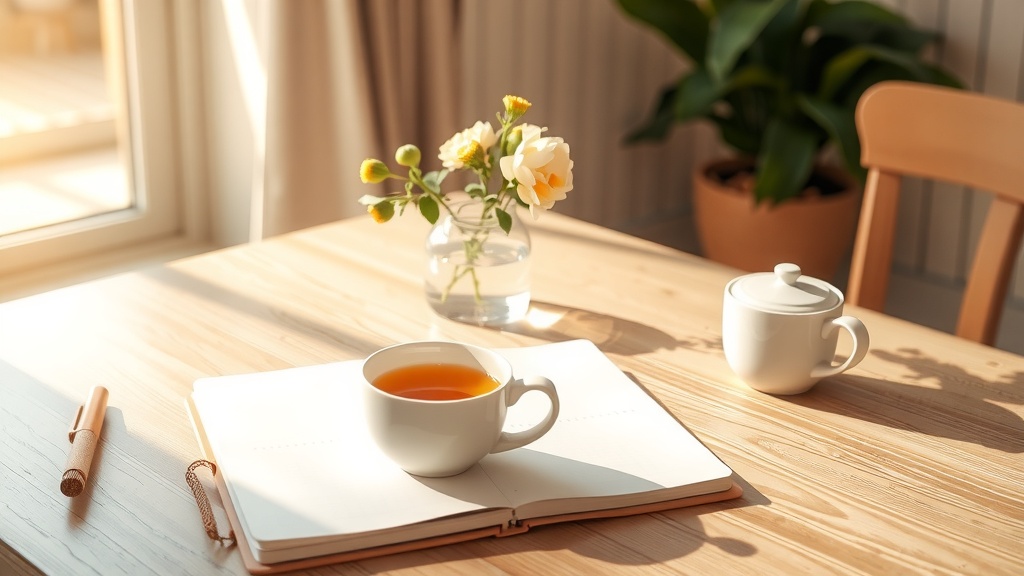
- A screen-free morning window. Before you reach for your phone, give yourself ten minutes. A cup of tea, a window, the light. Nothing more.
- One meal a day without distraction. Sit down, put your plate on the table, and eat. Notice the flavour, the smell, the texture. This is a meditation that tastes good.
- A walk without headphones. Once a week, go outside without a podcast or music. Just your footsteps, the air, the sounds around you. You might hear birds you haven't really listened to in years.
- Full contact in conversation. When someone is talking to you, place your phone face down. Look at the person in front of you. It's a small gesture with a quietly large effect.

The beauty of things that pass
In Japanese culture there is a concept called mono no aware. It translates, roughly, as the bittersweet tenderness of impermanence. Cherry blossoms are beautiful precisely because they last only a moment. A sunset is precious because it will never repeat itself in exactly the same way. And perhaps your afternoon today, with your child, your friend, your mother, is precious for the same reason. One day it will exist only as a memory.
This is not a reason for sadness. It is an invitation. An invitation to be where you are, with your whole self.
Caring for yourself as the foundation of caring for others
Death doulas learn one essential thing: you cannot accompany others if you are not grounded in yourself. And that is true for every one of us, whether we work in a hospice or simply live an ordinary day. Taking care of your own calm, your sleep, your body and your mind is not selfishness. It is the ground from which you can give to others.
Sleep enough. Go outside. Cook from fresh ingredients. Say no to things that drain you. Say yes to moments that fill you. These small choices are not just about health. They are about how you want to spend your time here.
One small ritual for this week
Try asking yourself one question each evening before you fall asleep: What did I actually experience today? Not what you got done, not what you managed. What did you feel. Maybe it was the smell of rain on the way home. Maybe it was laughter over lunch. Maybe it was a warm mug held in both hands.
These moments are there every single day. They are waiting for you to notice them.