Sometime in April, when the grass is just waking up and the air still carries a trace of winter, small white stars begin to appear in the meadows. The common daisy, whose Latin name Bellis perennis means quite literally eternally beautiful, blooms from early spring through to autumn – a quiet reminder that beauty does not need to be rare or complicated. Sometimes you just need to bend down and look.
A flower that belongs to the wild
The daisy is a true meadow and garden plant. She grows on lawns, in parks, along footpaths and at the edges of gardens. She asks for nothing special and seeks no attention. She simply blooms, year after year, in the same spot. And perhaps that quiet persistence is the most beautiful thing about her.
If you have a garden or even a small patch of lawn, try leaving one corner uncut through spring. You will be surprised how quickly the daisies find their space. They will draw in bees, bumblebees and butterflies, and you will have a living carpet that changes a little every day.
What the daisy quietly offers
People have gathered daisies for generations – not for grand medicinal recipes, but for small everyday rituals. Fresh leaves and flowers can be added to a spring salad. They carry a gently bitter flavour and are full of vitamin C. Old herbalists added them to teas for colds, or laid the cool leaves over tired eyes as a soothing compress.
- Spring salad: Young leaves and open flowers brighten any green salad – simply add them raw.
- Herbal tea: Pour hot water over a handful of dried flowers, steep for five minutes and stir in a spoonful of honey.
- Cooling compress: Lay fresh, lightly crushed leaves on your temples or closed eyelids for a calming, cooling sensation.
- Daisy chains: Long stems can be woven into simple garlands – a lovely slow activity for children and adults alike.
Small beauty that slows you down
There is something about the daisy that naturally slows us down. Perhaps because finding her means getting close to the ground. Bending toward her means stepping out of the rush for a moment and noticing the world at a scale we knew well as children. Daisy chains, picking them in a meadow, blowing dandelion clocks beside them – these are memories that live somewhere deep in all of us.
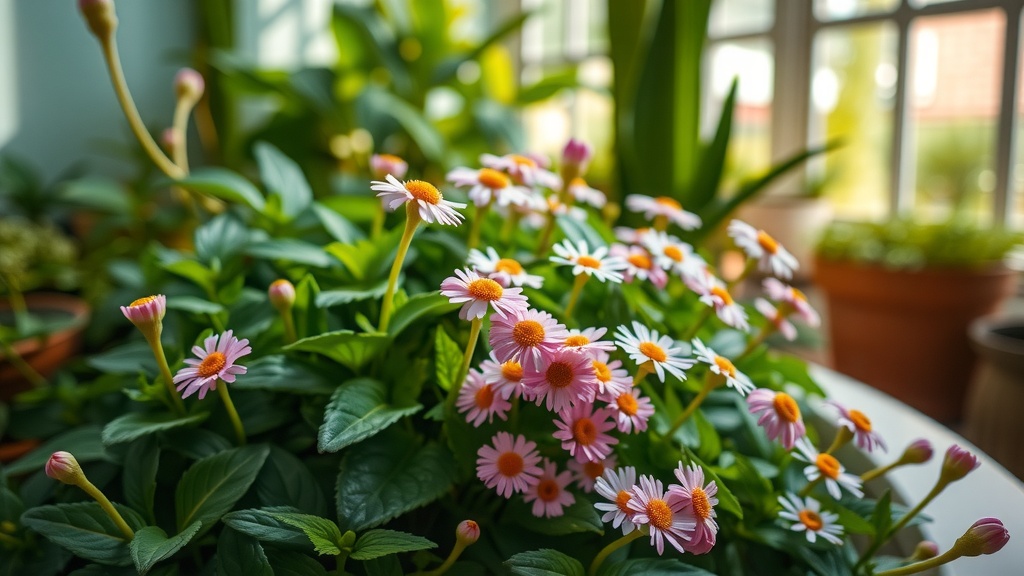
One charming detail: Bellis perennis closes her petals at dusk and on rainy days, as if protecting her golden centre from the cold. Each morning she opens again toward the sun. This small daily rhythm is a quiet reminder that we, too, need moments of closing and opening.
How to bring her closer
If you have no garden, a balcony or terrace with a window box works beautifully. Daisies will bloom all spring and summer with regular watering and an occasional feed. Choose the simple, natural flower over heavily bred varieties with oversized pompom heads. The original white petal with a yellow centre has something that no horticultural novelty can quite match.
And if you live in the city, all you need is a canvas bag, a small pair of scissors and a walk to the nearest park. A spring outing in search of daisies is a small therapy in itself – movement, fresh air, and attention given to the ground beneath your feet.
The daisy imposes nothing. She simply blooms – faithfully, quietly, year after year. And that may be the finest example of how to live.